When it comes to choosing composite decking, one of the most common questions is exactly this: should I go with a hollow board or a solid board? To answer that, it’s important to understand the differences between the two types, what the market offers and which situations suit each one best.
Not all composite decking is the same
Before comparing hollow composite decking with solid, there’s an essential point that’s often overlooked: not all composite decking has the same quality.
In most composite decking products available on the market — particularly those manufactured with Polyethylene (PE) or Polypropylene (PP) — hollow boards are not recommended in any situation, because the mechanical strength of these products is typically very low.
For this reason, the choice between hollow and solid only truly matters when the product has the quality required for both versions to be reliable.

What is a hollow composite decking board and a solid board?
The difference between the two types lies in the internal structure of the board.
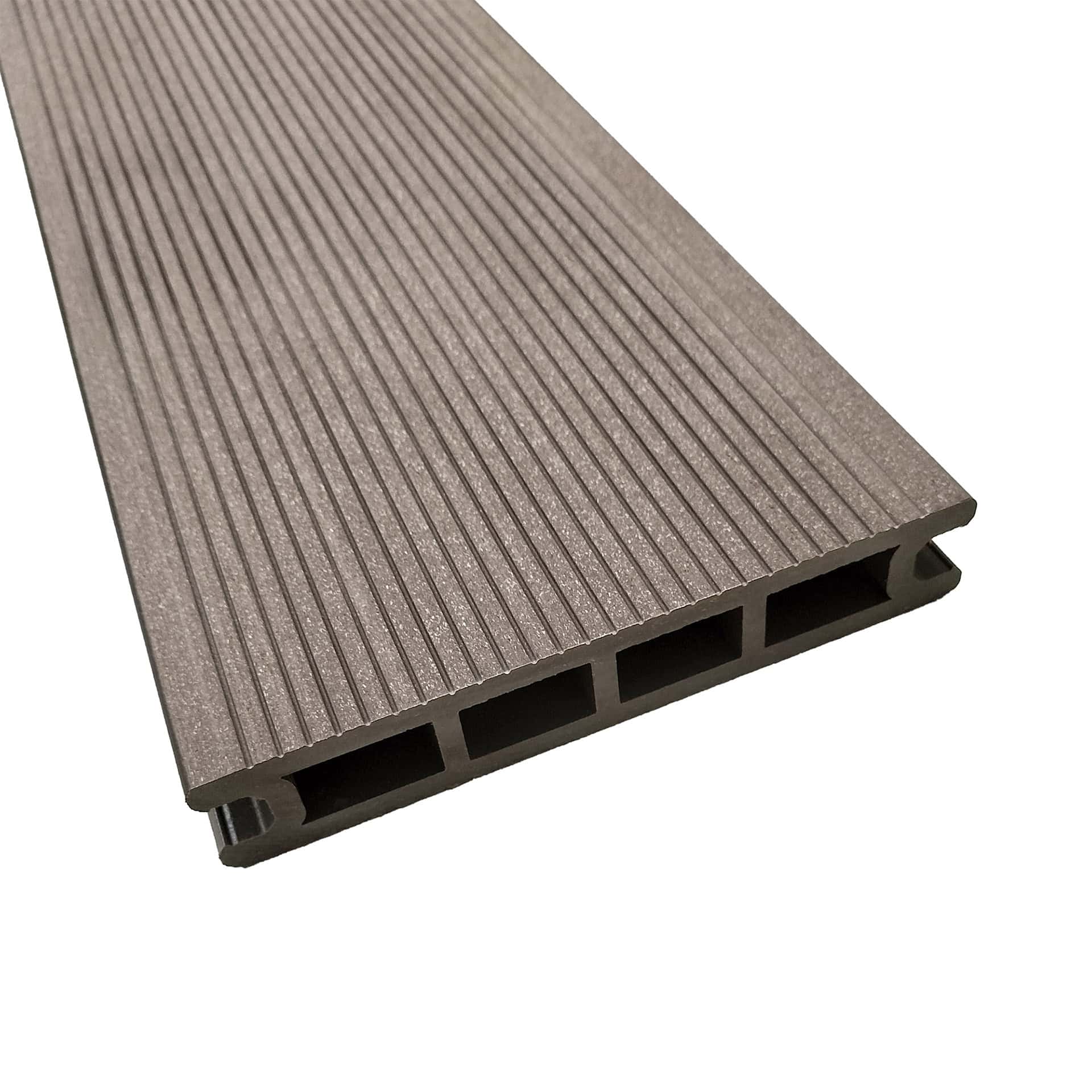
A hollow composite decking board has air chambers inside — known as hollow cores — which reduce the weight of the board and allow some internal ventilation.
A solid board is completely solid, with no air chambers. Greater mass and, under certain conditions, greater impact resistance.
Hollow and solid boards — CDECK Original
CDECK Original® is a European manufacturing composite decking range available in both hollow and solid boards. Both share the same dimensions (2300 × 140 × 24 mm), the same 6 colours and the same installation configuration — making it possible to combine them within the same project.
Unlike most products on the market, the CDECK hollow composite decking board is stronger than the majority of solid composite decking boards available. The mechanical strength of decking manufactured with Polyethylene (PE) or Polypropylene (PP) typically ranges between 25 and 50% of the strength of CDECK.
Advantages:
- More affordable — less raw material required.
- Lower solar heat absorption — the air chambers allow internal ventilation, resulting in lower surface temperatures under direct sunlight. A significant advantage in pool areas or regions with intense summers.
- Suitable for the vast majority of residential and commercial projects.
Disadvantages:
- Lower impact resistance compared to the solid version.

Advantages:
- Greater resistance to impact and shock.
- Lower dimensional variation with moisture and reduced water absorption — more stable in permanently wet environments.
Disadvantages:
- Higher price — a result of the greater volume of raw material used.
- Heats up more in direct sunlight than the hollow version — the greater mass and reduced exposed surface area result in higher surface temperatures under direct solar radiation.
Technical Comparison
The data below is taken from the official Declaration of Performance (DoP) for CDECK Original and allows a technical comparison of both versions.
Characteristic
Hollow Board
Solid Board
Bending strength (EN 310)
48 N/mm²
57 N/mm²
Impact resistance +23°C (EN 477)
80 cm — no rupture
200 cm — no rupture
Impact resistance −10°C (EN 477)
100 cm — no rupture
200 cm — no rupture
Point load capacity (EN 1533)
6,810 N
8,780 N
Water absorption (EN 317)
1,1%
0,6%
Thickness swelling (EN 317)
0,4%
0,3%
Note: IHT assumes a variation of 30% due to the production process and exposure to climatic factors.

When does a solid board make sense?
In the context of CDECK Original, solid composite decking is only justified in very specific situations:
- Extremely cold environments — locations where temperatures can drop below −20°C.
- Extreme and permanent humidity — such as saunas or indoor swimming pools with consistently high temperature and humidity.
- Risk of total or partial submersion — environments or areas with a high risk of boards being fully or partially submerged, or where water is likely to enter the hollow cores.
- Areas exposed to significant mechanical impact — for example, hospitality settings where heavy items such as beer kegs or gas cylinders are regularly unloaded.
The choice between hollow and solid composite decking is not a matter of one being better than the other — it’s about matching the right solution to the actual conditions of the project. For the vast majority of applications, the hollow version of CDECK Original offers everything you need. The solid version exists to meet genuinely demanding conditions.
CDECK® composite decking
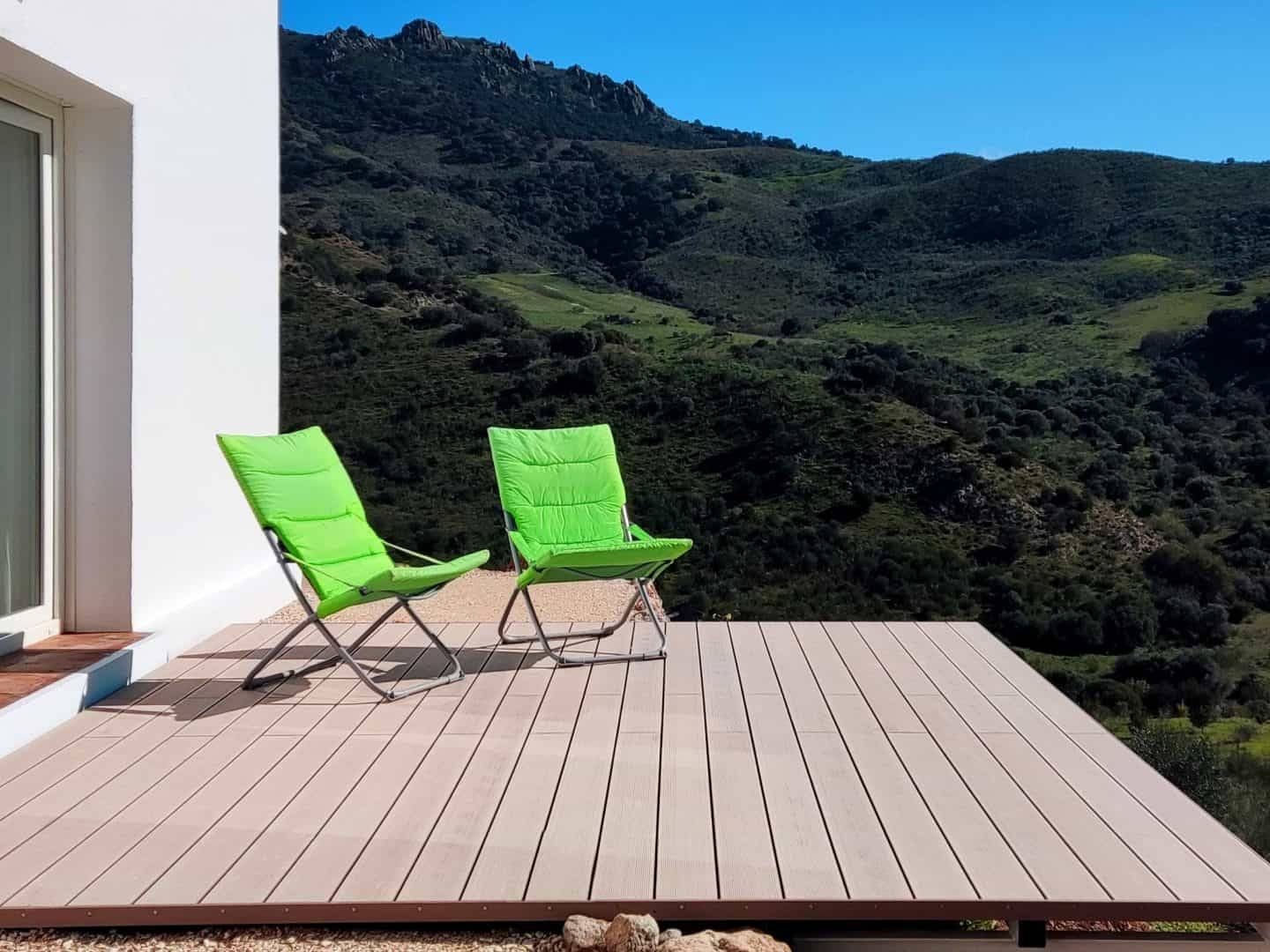
Manufactured in the European Union with a warranty of up to 25 years, CDECK is available in two ranges: CDECK Original®, in both hollow and solid versions, and CDECK WUUDE®, with an encapsulated finish that recreates the authentic look of natural timber.
Frequently Asked Questions
Yes. The hollow and solid boards in the CDECK Original range share the same installation configuration, which means both types can be used together within the same project.
With CDECK Original, the solid version tends to heat up more. Due to its greater mass and reduced exposed surface area, it retains more heat under direct sunlight. The hollow version, thanks to its internal air chambers, reaches lower surface temperatures.
In the case of CDECK Original, the hollow board has lower impact resistance than the solid board in the same range — but it is stronger than the majority of solid composite decking products available on the market.