


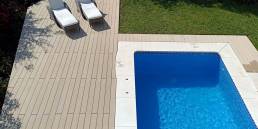
Composite decking is an innovative and sustainable solution, ideal for transforming terraces, balconies, outdoor seating areas, gardens, or pool areas into comfortable, elegant, and durable spaces.
To ensure the best performance of the material, it is essential that composite decking installation follows all the recommendations in the technical datasheet.
In this article, we present the most common mistakes in CDECK composite decking installation and explain how to avoid them, ensuring that your flooring maintains its beauty, safety, and durability over the years.
Why Proper Installation Is Essential
Even high-quality products like CDECK® rely on correct application according to best practices.
Incorrect installation can compromise:
- The system’s durability;
- Walking comfort;
- Structural safety;
- And the flooring’s appearance.
Following the technical data sheet ensures a stable, durable, and visually harmonious floor, extending the deck’s lifespan.
5 Common Mistakes in CDECK Installation
Mistake 1 — Incorrect spacing between joists in composite decking installation
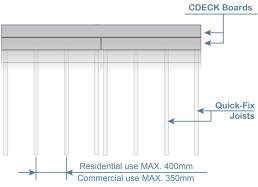
One of the most important aspects of composite decking installation is the correct spacing between the Quick-Fix joists. If these distances are not respected, the deck may develop unevenness, lose stability, or warp over time.
Spacing varies depending on the intended use of the space:
- Residential use
Private areas with moderate traffic, such as gardens, balconies, terraces, or pool areas in homes. Maximum distance between joists: 400 mm. - Commercial use Spaces subject to higher usage intensity, such as outdoor seating areas, walkways, outdoor dining areas, or pools in hotels and resorts. Recommended maximum distance: 350 mm.
These measurements should be taken from the center of one joist to the center of the next.
You may reduce the spacing to reinforce the structure, but never exceed the recommended values.
Following these guidelines ensures the stability, safety, and longevity of your CDECK composite decking.
Mistake 2 — End to end boards poorly supported in composite decking installation
In lagged assemblies, where two boards meet end to end, using only one Quick-Fix joist can compromise the structure’s stability.
The correct solution involves:
- Using two Quick-Fix joists, one for each board.
- Ensuring that each board is supported by at least three joists, regardless of the distance between them, providing a firm, level, and durable base.

Mistake 3 — Lack of fixing or incorrect fixing of the joists during composite decking installation
The stability of a deck starts at the base — it is the joists that ensure the firmness and safety of the entire structure. In the case of CDECK composite decking, these joists can be made of PVC or aluminum, depending on the type of installation.
During installation, it is essential to correctly fix the joists to the ground and respect the proper spacing between screws:
- Maintain 40 to 80 mm between the screw and the end of each joist;
- For PVC joists, place screws at a maximum of every 500 mm;
- For aluminum joists, place screws at a maximum of every 600 mm.

Mistake 4 — Gaps and expansions: essential detail in composite decking installation
Expansion gaps are essential in any composite decking installation.
The composite naturally expands and contracts with changes in temperature and humidity, so it is crucial to ensure these gaps in composite decking installation:
- Between boards and fixed elements (such as walls or fences): minimum 15 mm
- Between the ends of boards: minimum 6.5 mm
Respecting these distances prevents warping, lifting, or structural damage.

Mistake 5 — Incorrect fixing of boards during composite decking installation
One of the most serious mistakes in CDECK deck installation is the incorrect fixing of boards — either by not fixing them at all or by fixing them on all clips. This often happens due to a lack of knowledge about the Quick-Fix system.
To ensure correct installation, you should:
- Use only one screw per board to fix the clip closest to its center, preventing longitudinal movement.
- Do not place more than one screw per board and do not screw the clips to the joists.
Ensuring the correct fixing of boards prevents the deck from losing stability, avoids movement and misalignment of boards, and prevents irregular gaps.

The correct composite decking installation is crucial to ensure the durability, safety, and aesthetics of your deck.
Consult the complete CDECK composite decking installation guide and the step-by-step installation videos available.
Discover the CDECK range
Frequently Asked Questions about Composite Decking Installation
You should follow the latest technical data sheet and the step-by-step installation videos available on the official page How to Install CDECK Composite Decking.
The Quick-Fix system simplifies the installation and maintenance of CDECK composite decking. With only one screw per board, it ensures a quick, practical, and stable fit. It includes special clips, such as the Quick-Fix Pro, which allow individual boards to be opened and removed, facilitating access to drains, inspection boxes, or cleaning specific areas. The floating structure adapts the deck to dimensional changes, increasing durability and long-term performance.
No. It is crucial to respect the spacing between boards, as temperature and humidity cause expansion and contraction. Ignoring these gaps can cause warping, lifting, or cracking of the deck and may affect adjacent materials, including walls, compromising the safety and performance of the deck.
Yes. It is possible to install CDECK composite decking on soil, provided that a crossed structure is used as indicated in the technical data sheet. It is essential to compact the soil at the support points and keep the lower air gap unobstructed, for example by using a geotextile mat, to ensure the stability and durability of the deck.
No. When installing composite decking, the boards should never be placed directly on the soil. It is mandatory to maintain an air gap between the boards and the ground, ensured by the Quick-Fix joists, providing ventilation, preventing moisture, and preserving the deck’s durability and stability.
No. The CDECK joists must be securely fixed to the ground or to other profiles that guarantee a locked structure, as indicated in the technical data sheet.
No. CDECK has been developed and tested as a complete system, where each component has a specific function. It must always be installed with its own accessories and according to the technical data sheet instructions, ensuring long-term durability and stability.