
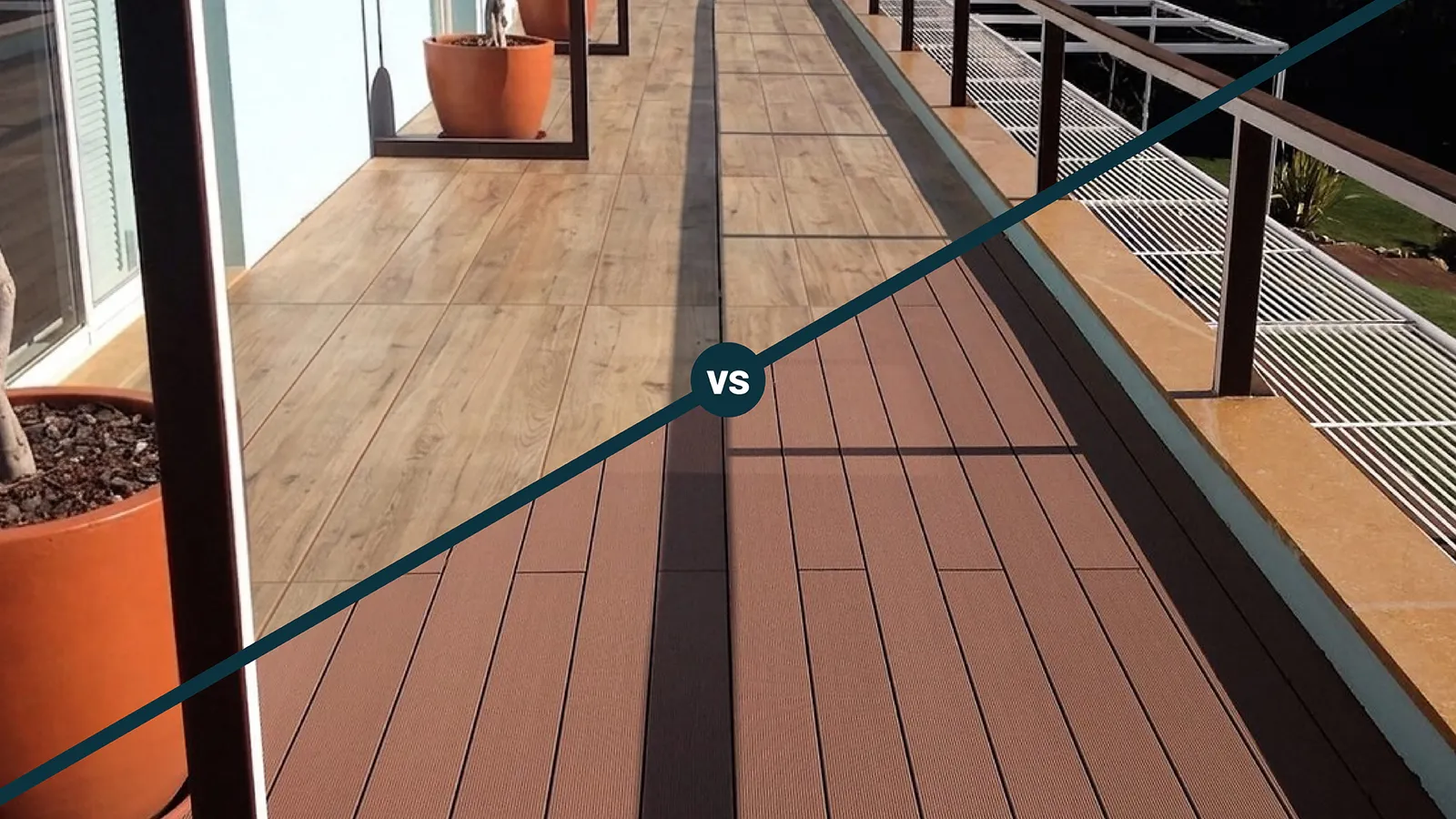
Ceramic decking and composite decking are two of the most popular flooring choices in Portugal for terraces, gardens, balconies and poolside areas. Both look good and are easy to clean, but they perform very differently in terms of safety, resistance and installation. In this article, we compare the two criterion by criterion and help you choose according to your space.
Ceramic decking and composite decking: what they are
Ceramic decking
Ceramic outdoor flooring, available in a wide variety of colours, textures and patterns, including wood-, stone- and marble-effect finishes. It is valued for its abrasion resistance, dimensional stability and ease of cleaning. In most cases, it is bonded to a concrete slab.
CDECK composite decking
Boards made from a composite of wood fibres and PVC that recreate the look of natural wood. They are fixed with the Quick-Fix® system on supports, creating a raised floor that lets water drain away underneath.
Ceramic vs. composite decking: a side-by-side comparison
| Criterion | Ceramic decking | CDECK composite decking |
|---|---|---|
| Appearance | A wide variety of colours, patterns and textures, including wood-, stone- and marble-effect finishes. Pieces typically measure between 0.5 and 1.2 m, which can limit the look in large spaces. | Several colours and finishes that recreate wood. Boards of 2.3 m or made to measure, between 1.8 and 3 m. |
| Safety and comfort | Can become slippery when wet, especially with use over time. Absorbs heat in hot climates and becomes uncomfortable to the touch. | Class 3 slip resistance (EN 15534), even when wet. No knots or splinters, comfortable under bare feet. |
| Durability | High abrasion resistance and dimensional stability. Can last for decades if not subjected to impacts, but cracks or breaks when objects are dropped on it or with significant temperature changes. | Resistant to the weather and to significant temperature changes. Does not rot or crack and offers high impact resistance. |
| Maintenance | Easy to clean and stain-resistant, with no treatments needed. The joints collect dirt and require more careful cleaning. | Cleaning with water and a mild detergent. The boards can be removed for deeper cleaning underneath. |
| Installation | Bonded, it requires a solid, level concrete slab. Where the base sinks, puddles form, and accessing the area beneath means breaking pieces. | Quick-Fix® system, with just one screw per board and installation up to 3× faster*. Adapts to different bases, water drains away underneath and the area below can be accessed without breaking anything. |
| Cost | More economical over an existing slab. Over bare ground, building the slab first can match or exceed the cost of composite. | Over a slab, the upfront investment is usually slightly higher. Over bare ground, it is similar or slightly lower. Better value for money in the medium and long term. |
.CCXDl_jX_yhi0A.webp)
The most common questions
What happens if a ceramic tile breaks?
It has to be replaced, and it is not always possible to find the same batch or the same reference. With CDECK, each board can be removed individually and replaced without disturbing the others.
What if I don't have a level slab?
Bonded ceramic decking needs a solid, level concrete slab, and building one can mean a significant additional cost. CDECK does not require a level slab: the Quick-Fix® system adapts to concrete slabs, existing flooring, and uneven surfaces or surfaces that cannot be drilled, such as waterproofing membranes. It can also be installed over compacted ground, with the appropriate substructure.
What about raised ceramic decking?
Laid on supports rather than bonded, ceramic decking needs no adhesive, lets water drain away and allows access underneath. It does, however, retain the characteristics of ceramic itself: it can become slippery when wet and break under impact.
Can I replace my ceramic decking with composite decking?
Yes. Existing ceramic flooring can serve as the base for installing CDECK with the Quick-Fix® system, provided it is in good structural condition. Our team can help you assess the best solution for your space.
Contact usCeramic or composite decking: which should you choose?
Choose ceramic if you want a mineral finish, such as stone, marble or polished concrete, already have a level slab and don’t mind cleaning the joints regularly.
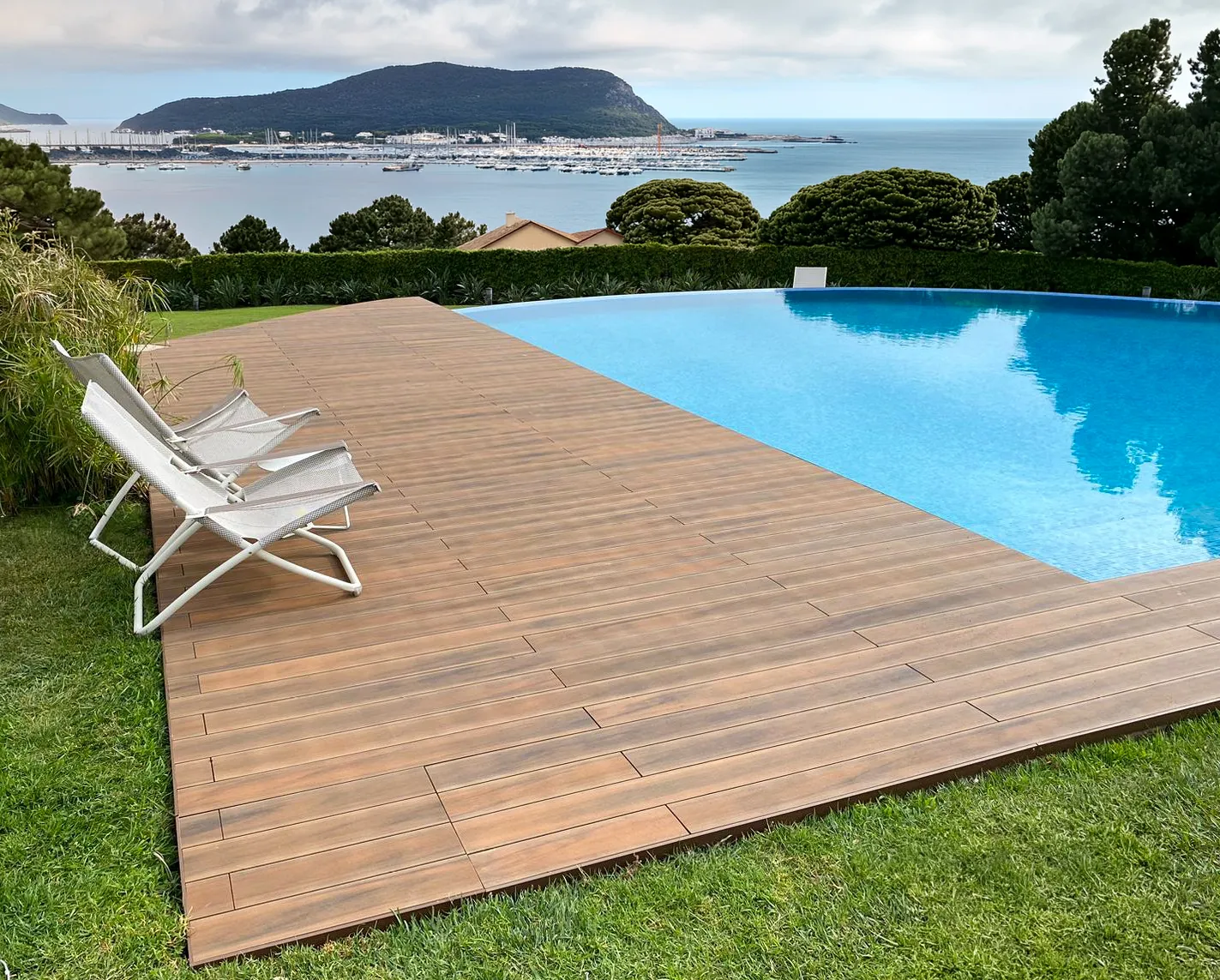
Choose composite if the space is a poolside area, a garden with children or pets, or a balcony exposed to rain, if you don’t have a level slab, or if you need access beneath the floor.
CDECK comes in two ranges: CDECK Original®, with hollow or solid boards, and CDECK WUUDE®, with a capped finish.
_piscina.BSDuopYr_1MqL6g.webp)