
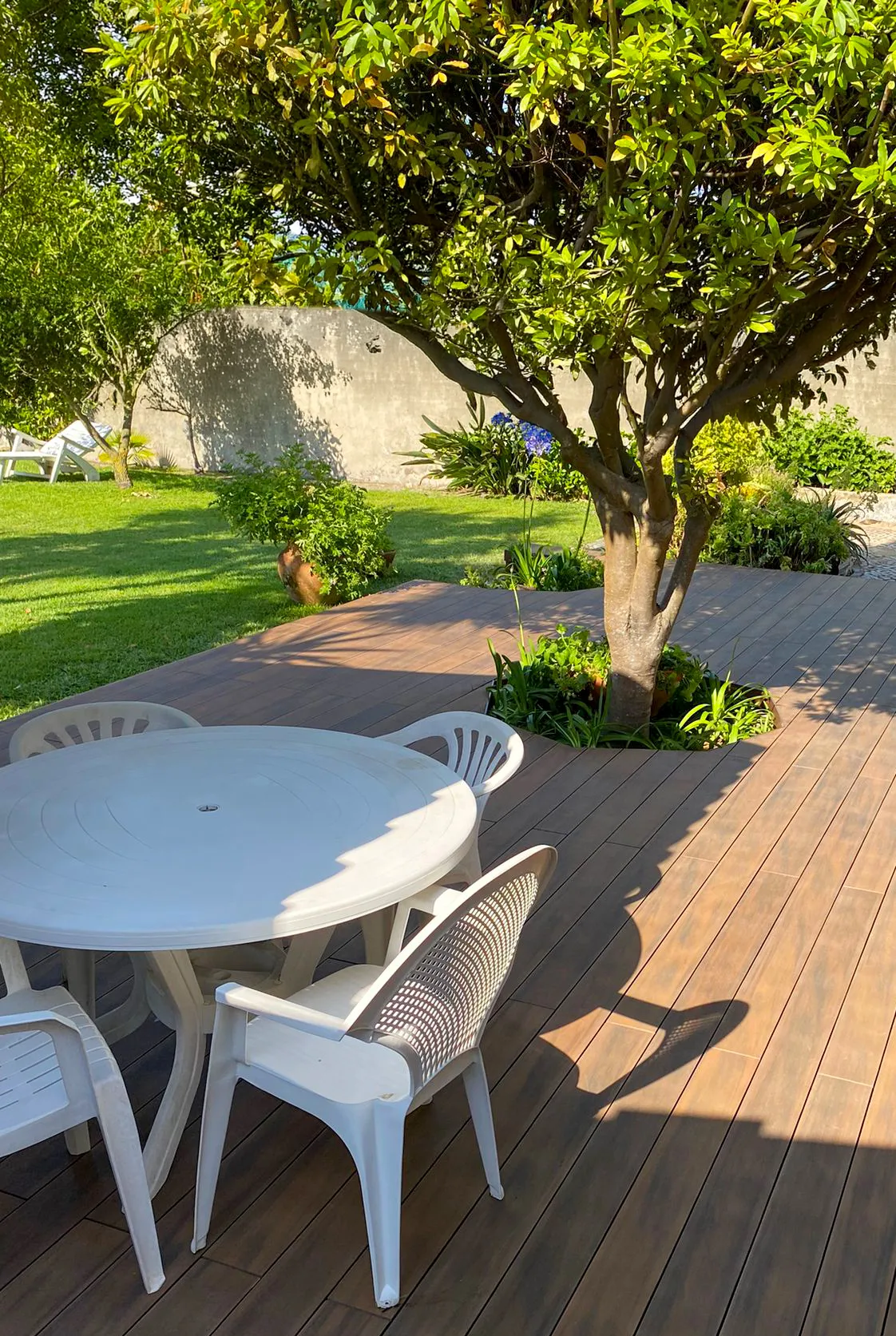
Looking for the price per square metre of composite decking? The honest answer is that there is no single price: the cost depends on your project. The same decking can cost significantly more or less depending on the type of base, finishing details and how the space will be used. In this guide, we explain what determines the price and how to calculate the actual cost of your project in just a few minutes.
Calculate your total decking cost
Design your project and get a total price estimate in minutes.
Calculate my priceWhy doesn’t the price per m² tell the whole story?
Comparing composite decking based solely on its price per square metre can be misleading. Two terraces with the same price per m² can end up costing very different amounts: product quality, the condition of the base, cutting requirements and intended use all have an impact. That is why, rather than relying on an average price that may not reflect your project, what really matters is the total cost of your project — the amount you will actually pay.
What factors determine the price?
Product quality
Not all “composite decking” is created equal, and composite decking is not the same as 100% synthetic decking (plastic). Composite decking combines wood fibres and polymers, but its strength, durability and warranty can vary significantly from one manufacturer to another. A premium board, manufactured in the European Union, with good dimensional stability and a warranty of up to 25 years, starts at a different price point from a low-cost, lower-strength composite product — and can prove more cost-effective over time.
Installation method
The base you are installing on determines the structure required — joists, supports and accessories — and therefore a significant part of the material cost. Installing on a level concrete slab is not the same as installing on an uneven surface or a non-drillable base.
Surface complexity
A clear, rectangular terrace requires less work and fewer accessories than one with curves, multiple cuts, changes in level or stairs. Every edge, corner and step may require specific components, adding to the overall cost.
Residential or commercial use
For commercial applications, such as restaurants or high-traffic areas, the substructure needs to be reinforced. Joists are installed closer together, increasing the number of supports, clips and screws required per square metre and, consequently, the amount of material needed.
The three installation methods and how they affect material requirements
CDECK offers three installation methods depending on the type of base. Each one determines the structure and materials required:
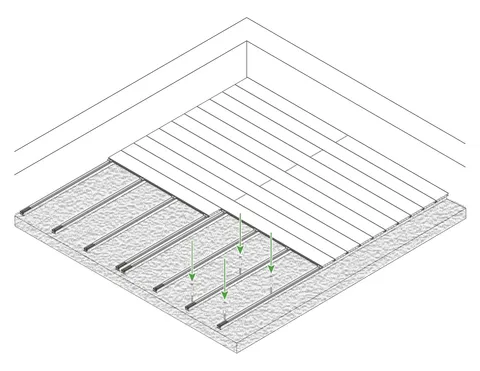
Regular base
For concrete slabs or other solid, level and drillable bases. Joists are fixed to the ground with screws.
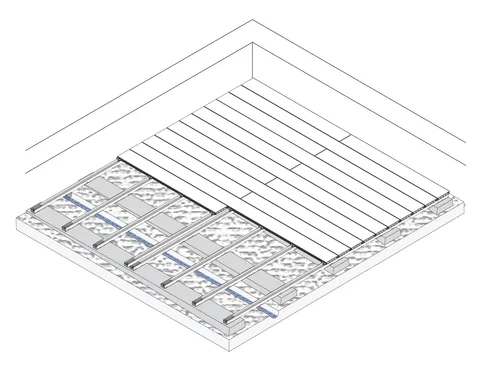
Uneven base
For drillable bases with changes in level. Joists are fixed with screws, creating a substructure that compensates for surface irregularities.
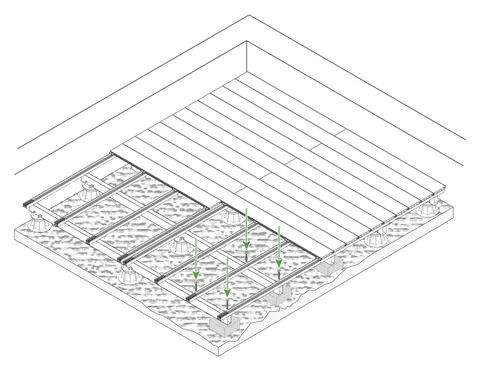
Raised or non-drill installation
For non-drillable bases, such as waterproofing membranes, compacted ground or soil, or when the finished level needs to be raised. The braced substructure is installed on supports without drilling into the base.
How to find the actual cost of your decking
As the price depends on all the factors above, the most reliable way to find out what your decking will cost is to calculate it based on your specific project:
Before you start, explore our two ranges: CDECK Original (colour throughout the board, available in hollow or solid profiles) and CDECK WUUDE (co-extruded finish with a more realistic appearance).
_piscina.BSDuopYr_1MqL6g.webp)