Two profiles
Hollow and solid boards, which can be combined on the same deck.

Our classic composite decking board, with a grooved finish and colour running throughout the material. A premium, strong and durable composite you can install yourself. Choose from six colours and two profiles: hollow or solid.
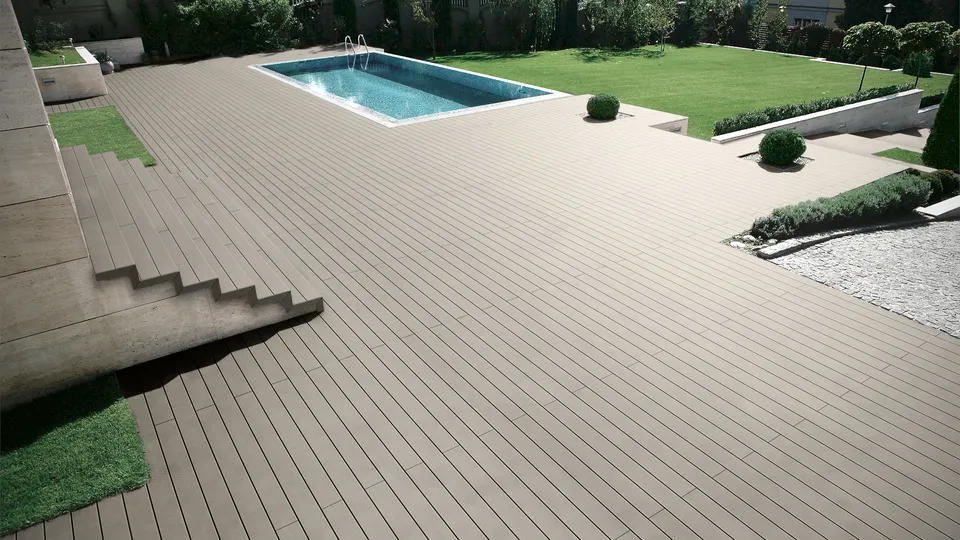

A composite designed for outdoor use down to the smallest detail. Strong and stable, it requires very little maintenance. Find out more about cleaning and maintenance
Hollow and solid boards, which can be combined on the same deck.
A classic, timeless look.
Ideal around swimming pools or on restaurant terraces. Class 3 (EN 15534).
A more comfortable and safer surface under bare feet.
Will not rot; suitable for damp and saline environments.
Good colour stability outdoors over time.
Low susceptibility to biological degradation from fungi, insects and termites.
Even with changes in temperature and humidity.
The patented Quick-Fix® fixing system uses just one screw per board, making installation fast and individual boards easy to remove when needed. See also our installation and finishing accessories.
Easy to cut and drill.
From responsibly managed forests and 100% recyclable.
Manufactured in Portugal.
Two board profiles, one system. Same dimensions, same six colours and the same Quick-Fix® installation system. You can even combine both profiles on the same deck.
| Criteria | Hollow | Solid |
|---|---|---|
| Structure | Lightweight board (internal air chambers) | Fully solid board |
| In the sun | Heats up slightly less | Heats up slightly more |
| Key benefits | Lightweight, versatile, economical | Higher impact resistance, more stable in humid environments |
| Best for | Most outdoor projects | Demanding conditions (severe cold, high humidity, impact) |
For most decking projects, the hollow board is more than sufficient. Find out more: hollow or solid?
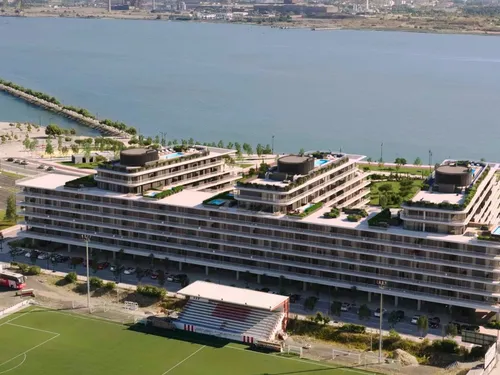
See CDECK Original® composite decking in real residential and professional projects.
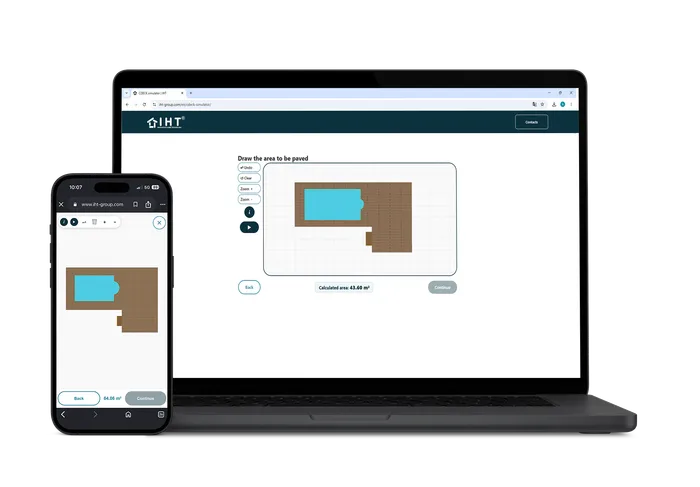
Design your deck, choose your colours and get an estimate in just a few minutes.
Configure my deckThe data below summarise the values declared in the Declaration of Performance (DoP) for CDECK Original boards – hollow and solid. Download the DoP for the complete version.
| Characteristic | Hollow board | Solid board |
|---|---|---|
| Dimensional tolerances | ||
| – Length | – 5 / + 15 mm | |
| – Width | ± 1 mm | |
| – Thickness | ± 0,7 mm | |
| Mass per metre | 2,42 kg/m | 4,16 kg/m |
| Mass tolerance | ± 0,2 kg/m | |
| Composite density | 1,387 g/cm³ | |
| Density tolerance | ± 0,15 g/cm³ | |
| Characteristic (method) | Hollow board | Solid board |
|---|---|---|
| Reaction to fire (EN ISO 11952-2, EN 13501-1, EN ISO 9239-1) | Bfl-s1 | NE |
| Effect of moisture | ||
| – Thickness swelling (EN 15534-1) | 2,3 % | 1,1 % |
| – Water absorption (EN 15534-1) | 5,5 % | 1,9 % |
| Flexural strength (EN 310) | 53 N/mm² | 58 N/mm² |
| Modulus of elasticity (EN 310) | 6447 N/mm² | 6026 N/mm² |
| Impact resistance (EN 477) | ||
| +23 °C / 1 kg | 15,5 J | > 20 J |
| −10 °C / 1 kg | 9,5 J | > 20 J |
| Slip resistance (EN 15534-1) | ||
| – longitudinal direction, dry conditions | 91 | |
| – longitudinal direction, wet conditions | 60 (Class 3) | |
| – transverse direction, dry conditions | 86 | |
| – transverse direction, wet conditions | 62 (Class 3) | |
| Screw withdrawal resistance (EN 1383) | 1890 N | 1874 N |
| Moisture under cyclic conditions (EN 15534-1) | ||
| – Reduction in flexural strength | fm = 10,24 % / 17,20 % | fm = 6,83 % / 20,67 % |
| – Reduction in modulus of elasticity | Em = 17,97 % / 26,63 % | Em = 12,76 % / 20,74 % |
| UV radiation – Charpy impact strength (EN ISO 4892-2 method A, EN ISO 179-1) | Before ageing: 7,1 kJ/m² After ageing: 4,6 kJ/m² | |
| Surface hardness (EN 1534) | 106 N/mm² | 108 N/mm² |
| Density (EN ISO 1183-1) | 1,387 g/cm³ | |
| Thermal resistance R / Equivalent thermal conductivity λ | R10 (23, 50) = 0,20 m²·K/W · λ10 (23, 50) = 0,124 W/(m·K) | R10 (23, 50) = 0,15 m²·K/W · λ10 (23, 50) = 0,165 W/(m·K) |
| Characteristic (method) | Value |
|---|---|
| Thermal expansion coefficient (ASTM E228, EN 821-1) from −40 °C to 80 °C | (21,3 ± 0,1) × 10⁻⁶ K⁻¹ (x-axis) (50,6 ± 0,8) × 10⁻⁶ K⁻¹ (y-axis) |
Note: IHT allows for a 30% variation associated with the manufacturing process and exposure to climatic factors.
¹ Based on European Technical Assessment ETA 26/0031 dated 27/02/2026.
² Based on test report "Thermal Expansion of Decking Material" 2013020350/1.
NE – Not evaluated.
Slightly, and in a predictable way. As a wood-fibre composite, the colour lightens during the first few months to settle into a more natural shade, then stabilises. After that, the colour and texture remain virtually unchanged.
Like any outdoor surface, yes – darker colours more than lighter ones. Hollow boards heat up slightly less than solid boards thanks to their internal ventilation. For areas with strong sun exposure, choose a lighter colour such as Beech Beige.
Its estimated service life is over 30 years under normal use and maintenance conditions, with a warranty of up to 25 years.
Hollow boards are suitable for the vast majority of projects and heat up slightly less. Solid boards are more robust and recommended for heavy footfall or demanding conditions such as frost and high humidity. Both profiles share the same colours, dimensions and installation system – and can be combined on the same deck.
Yes to both. The surface achieves Class 3 slip resistance (EN 15534), including when wet. It is resistant to chlorine and salt water, making it ideal around swimming pools – simply avoid prolonged contact with concentrated products and permanent immersion.
Regular cleaning with water and a neutral detergent is enough. No sanding, painting or varnishing. When using a pressure washer: maximum 150 bar, keep it 30 cm from the surface and always work along the length of the boards.
The boards are coloured throughout, making minor scratches barely noticeable. They offer good dimensional stability and high abrasion resistance. There are six colours, two profiles that can be combined, and a patented installation system designed for speed. The main trade-off is a generally higher initial investment than timber, which is quickly offset by the low maintenance requirements.
Tell us the type of base and the approximate area, and our team will get back to you shortly.
Fields marked with * are required.
.DOQPCbAu_ZFvxUK.webp)
.D2HzAeh5_Z1LVl74.webp)