When choosing composite decking, one question comes up again and again: should you go for hollow or solid boards? To make the right choice, it helps to understand what really sets the two apart — and when each option makes sense.
Not all composite decking boards are equal
Composite quality varies considerably from one product to another. With many boards on the market, particularly those made from polyethylene (PE) or polypropylene (PP), the hollow version is simply not recommended because its mechanical strength is often too low. Choosing between solid and hollow only becomes meaningful when the product quality is high enough for both versions to perform reliably.
Solid or hollow: what’s the difference?
The difference comes down to the board’s internal structure.
A hollow board contains internal air chambers, which reduce its weight and help ventilate the profile.
A solid board is dense all the way through: there are no air chambers, there is more material, and impact resistance is higher in certain conditions.


The two CDECK Original® profiles
CDECK Original® is available in both hollow and solid versions, manufactured in the EU. Both have the same dimensions (2300 × 140 × 24 mm), the same 6 colours and the same installation system, which means they can be combined within the same project.
Something that is relatively rare on the market: the CDECK hollow board is stronger than most solid boards sold elsewhere. The mechanical strength of PE- or PP-based composites is typically between 25% and 50% of that of CDECK.
Hollow version
What it offers
- A more accessible price, as it uses less raw material.
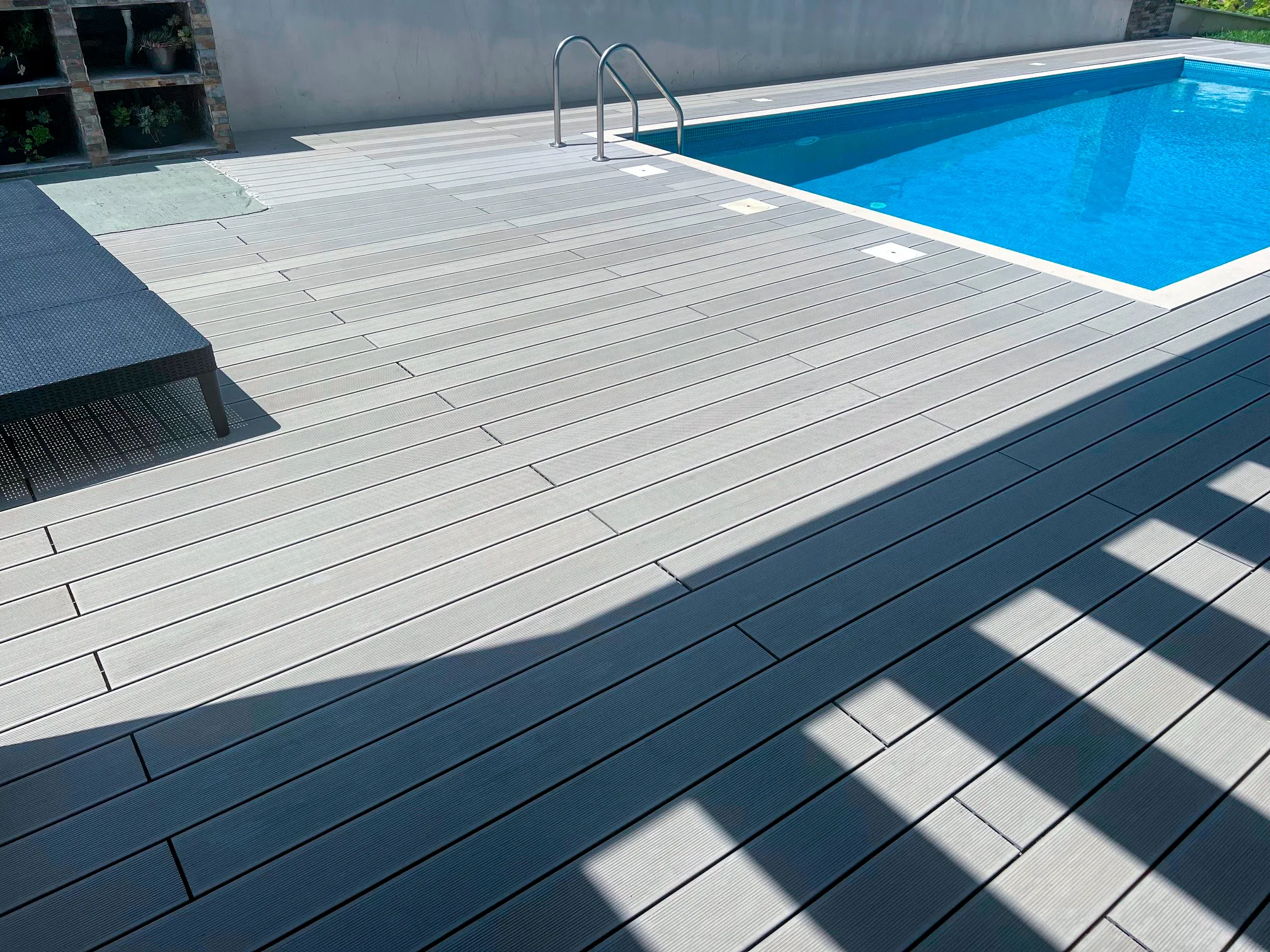
- A surface that heats up less in the sun: the internal air chambers ventilate the profile, which is particularly useful around swimming pools or in regions with hot summers.
- Versatility that covers the vast majority of residential and professional projects.
- Lower impact resistance than the solid version.
Solid version
What it offers
- Higher resistance to impact and knocks.
- Better stability in humid environments, with lower water absorption and less dimensional variation.
- A higher price due to the additional material.
- A surface that heats up more in the sun.
Technical comparison (DoP data)
Values taken from the official CDECK Original® Declaration of Performance (DoP).
| Characteristic | Hollow board | Solid board |
|---|---|---|
| Flexural strength (EN 310) | 53 N/mm² | 58 N/mm² |
| Impact resistance (+23 °C / 1 kg) (EN 477) | 15.5 J | > 20 J |
| Impact resistance (−10 °C / 1 kg) (EN 477) | 9.5 J | > 20 J |
| Water absorption (EN 15534-1) | 5.5% | 1.9% |
| Thickness swelling (EN 15534-1) | 2.3% | 1.1% |
Note: a 30% tolerance should be allowed for, due to the manufacturing process and exposure to climatic conditions.
When should you choose a solid board?
With CDECK Original®, the solid board is only really necessary in specific situations.
It is not a question of one profile being superior to the other, but of matching the board to the real conditions of the project. For the vast majority of decks, the hollow CDECK Original® board is more than sufficient. The solid version is designed for genuinely demanding conditions.
The solution
CDECK® composite decking
Manufactured in Europe and guaranteed for up to 25 years, CDECK® is available in two ranges: CDECK Original®, in hollow and solid versions, and CDECK WUUDE®, with a co-extruded finish that recreates the authentic look of natural wood.
.B41gmxyf_1VRjVy.webp)